Shared Universes
One World, Many Stories: The Value of Shared Universes

Have you ever finished a book and wished you could stay in its world a little longer? Maybe you wanted to know what happened beyond the town where the story took place. Maybe a minor character caught your attention. Or maybe the author created a world so interesting that one person’s journey couldn’t possibly satisfy your curiosity.
That is part of the appeal of a shared world.
A shared world, or shared universe, is a setting where multiple stories exist within the same fictional reality. Those stories may come from one author or many, with different characters, locations, and conflicts connected by an established history and a common set of rules. For readers, it offers more places to explore. For authors, it opens the door to collaboration and storytelling possibilities that can be difficult to achieve alone.
For Readers: A Bigger View of the Story
Most novels give us a limited view of their world. We follow certain characters and experience events through their eyes. But beyond those pages, other people would be living through their own struggles, victories, and very bad decisions. Shared worlds let us meet them.
In a post-apocalyptic universe, for example, one book might follow a family escaping a devastated city. Another could explore a rural community trying to decide whether to admit strangers. A third might take readers inside the government as its remaining leaders fight over what comes next. The same disaster connects them, but each story asks different questions. That variety gives readers a chance to explore a familiar world through different voices. One author might lean toward suspense, another toward adventure, and another toward the relationships that hold people together when everything else falls apart.
There is also the pleasure of recognition. A place mentioned in one book becomes the setting of another. A rumor turns out to have a story behind it. An event that seemed distant suddenly becomes personal. Those connections can reward readers who explore widely, while individual books still offer satisfying journeys of their own. Clear reading guidance helps readers know where to begin and whether a particular story depends on earlier books.
For Authors: Room to Create Together
Writing is often solitary work. A shared universe creates an opportunity to bring other imaginations into the process. An established world gives participating authors a foundation: its history, conditions, boundaries, and defining events. From there, they can develop characters and conflicts that reflect their own interests and strengths. One writer may be fascinated by political power. Another may want to explore ordinary people facing extraordinary choices. Another may see a story in a place nobody else thought to visit. Together, those perspectives can give the world greater depth.
Collaboration can also create opportunities for authors to introduce their work to new readers. Someone who discovers the universe through one book may become curious about another contributor’s stories. That possibility has value, although participation alone does not guarantee sales or an audience. The creative value matters, too. Conversations between contributors can uncover contradictions, inspire unexpected connections, and push everyone to think more carefully about the world they are building.
What Makes a Shared World Work?
Possibility needs a little structure. Readers need to trust that the world follows its own rules. If travel, technology, history, or the consequences of a major event change without explanation from book to book, the connections become confusing. Authors need enough guidance to maintain that consistency—and enough freedom to tell a story worth reading.
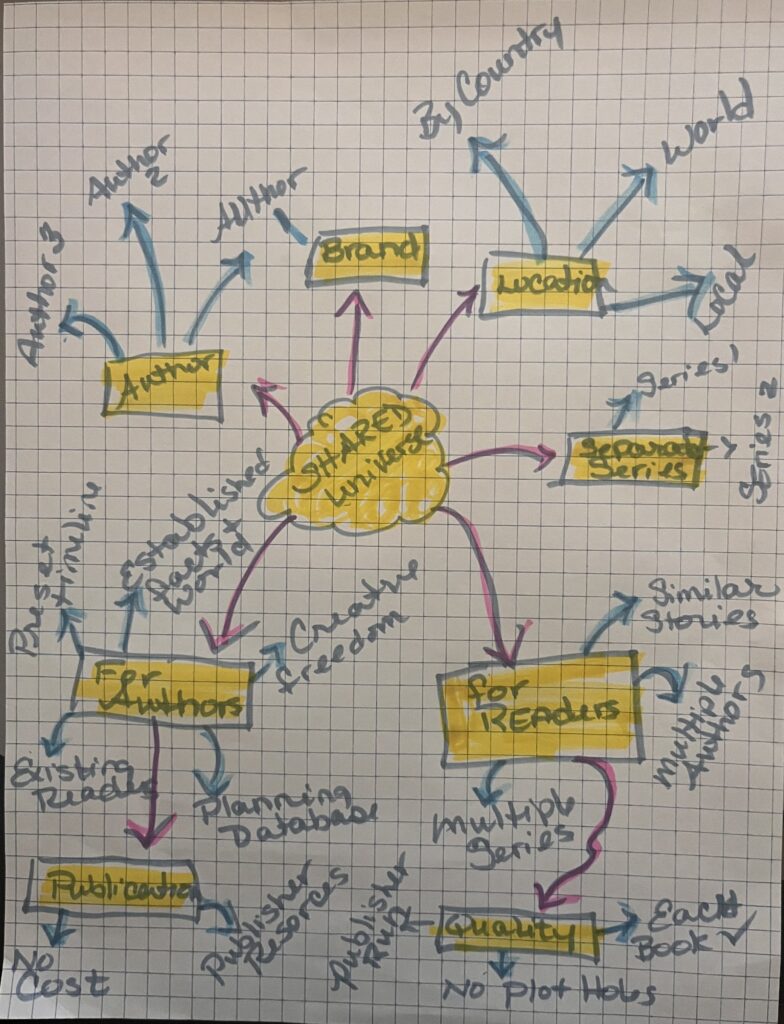
A useful world guide establishes what is already true, what remains open for invention, and how new details become part of the accepted continuity, often called canon. Clear expectations matter just as much. Contributors should understand ownership, compensation, approvals, credit, and how their work may be used before committing to a project. Good collaboration is easier when everyone knows where they stand.
Most of all, every story needs a reason to exist. A shared setting can attract interest, but readers still need compelling characters, meaningful stakes, and a journey that earns their attention.
A World Worth Returning To
The real value of a shared universe is the chance to discover how differently people can experience the same world. For readers, that means more doors to open. For authors, it means room to contribute something distinctive to a larger creation. One character may see a place as home. Another may see it as a threat. A third may be willing to risk everything to reach it.
There is a story in each of those perspectives—and a shared world gives us the opportunity to hear them.
Angry Eagle Publishing has two great worlds in the Apocalyptic Genre.